

Rebuilding Your Partner Program for the AI Economy
Partners now discover, sell, get paid, and get governed in ways your program was never built for. A five part masterclass on rebuilding it, one architectural decision at a time.

Issue No. 23
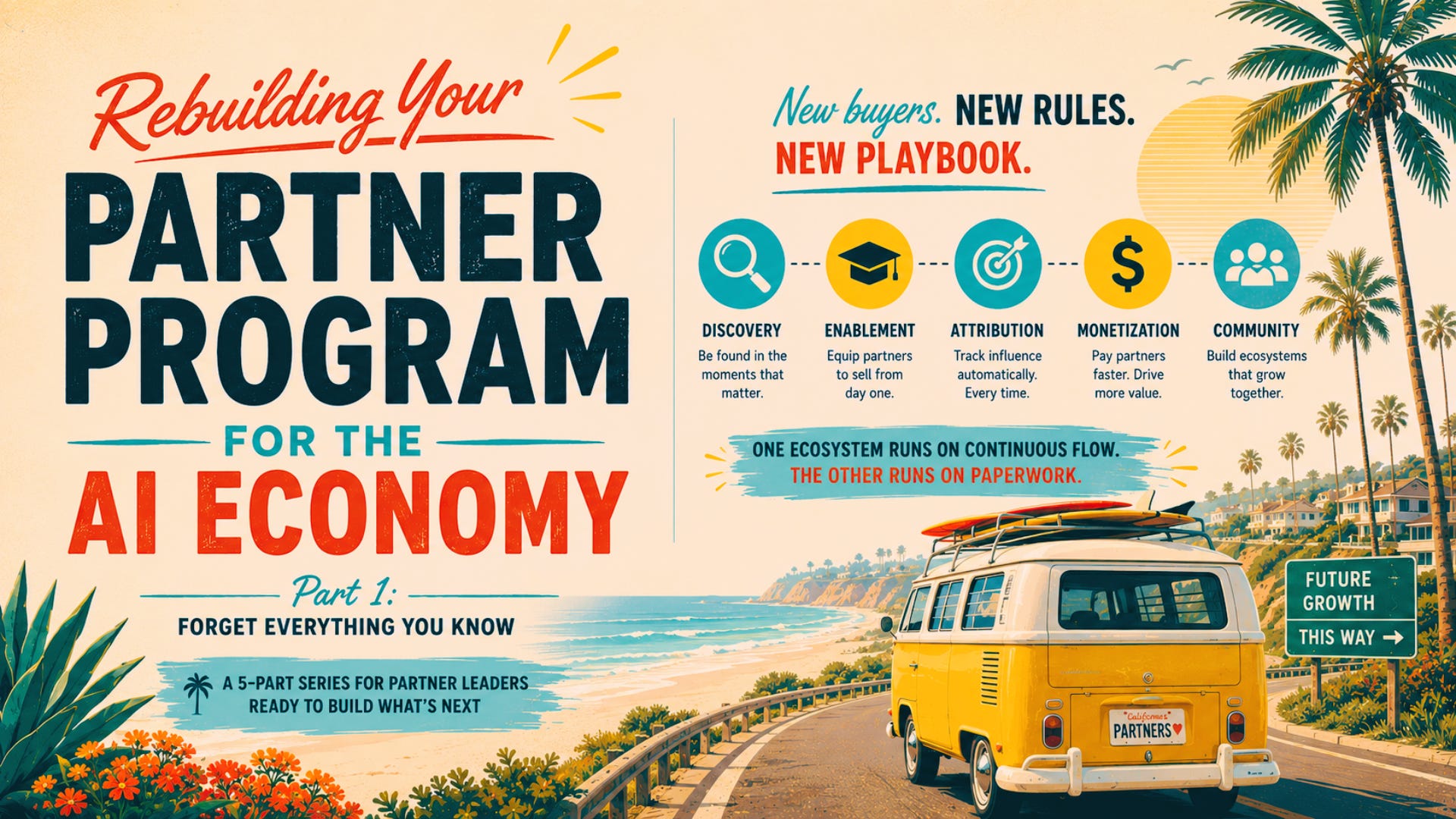
Part 1: Forget Everything You Know
Let’s skip the corporate PowerPoint and get to the interesting part.
If you are designing, scaling, or managing a partner program today using the same framework you used three years ago, it is time for a reset.
AI is not simply adding another tool to your tech stack. It is changing how partners discover, evaluate, sell, and support solutions. That requires a different operating model, not another round of incremental improvements.
Ideas are everywhere. Execution is what separates the companies that adapt from the ones that spend the next three years trying to catch up.
Here is what the rebuild is worth, so you know why the next five parts deserve your attention. Done right, you walk away with more partner-sourced pipeline, a fraction of the administrative drag your team carries today, faster deal velocity, and an ecosystem that adapts in weeks instead of quarters. That is the payoff. Now let me show you why almost nobody gets there.
I want to start this series somewhere that is going to feel strange for a partner leader. Because I think we have been asking the wrong companies for inspiration.
We have been studying the wrong ecosystem
For years, enterprise software has looked to other enterprise software companies for ideas. We benchmark against our competitors. We copy the tier structures of the giants. We attend the same conferences and read the same analyst reports and walk away with the same playbook everyone else is running.
Meanwhile, right under our noses, the creator economy quietly built a $2 trillion ecosystem growing at a 25 percent compound annual rate.
Platforms & Brands like Linktree, Stan Store, Kajabi, Shopify, TikTok, Instagram, LTK, YouTube, and Whatnot scaled hyper-velocity distribution, multi-partner coordination, and automated attribution without any of the heavy manual overhead that clogs traditional enterprise channels.
No portal logins. No tier qualification windows. No 30-day MDF reimbursement claims. No quarterly business reviews where 70 percent of the time is spent preparing the data instead of using it.
They built the thing we are all struggling to build. They just did not call it a partner program.
Many enterprise technology companies still see the creator economy as consumer-focused. They are overlooking one of the fastest-growing ecosystems in the world for building trust, driving discovery, and influencing buying decisions.
Two worlds that are actually the same world
At first glance, enterprise partner ecosystems and the creator economy look like two completely different worlds.
They are not.
Both succeed by building trust, creating discovery, enabling others to sell, and helping communities grow. The difference is that the creator economy figured out how to do all of it faster.
There is one architectural principle underneath that speed, and it is the through-line for this entire series. The creator economy runs on continuous data flow. Enterprise partner programs run on manual submission. A creator’s sale is tracked the instant it happens. A partner’s deal waits in a queue for someone to approve it. Hold that distinction. Continuous flow versus manual submission. It explains almost every gap we are about to walk through.
Look at what these platforms actually built, because every piece of it maps directly onto a function you are running manually right now.
Discovery. On Whatnot, a buyer finds a seller through a live feed matched to their interest in real time. In your program, a buyer finds a partner through a static directory they have to search by keyword, if they can find the directory at all.
Enablement. On Kajabi, a creator gets everything they need to sell packaged and ready the moment they sign up. In your program, a new partner gets a welcome pack, a portal login, and a certification track that expires in a year.
Attribution. On LTK and through Shopify's affiliate infrastructure, every sale is tracked to the creator who influenced it automatically, continuously, with no manual submission. In your program, a partner fills out a deal registration form and waits for someone to approve it.
Monetization. On Stan Store, a creator gets paid the moment value is delivered. In your program, a partner waits for a quarterly rebate calculation and a reimbursement cycle designed in 2008.
Same functions. Same goals. One ecosystem solved them with continuous flow and speed. The other is still solving them with headcount and forms.
Today’s buyers are not waiting for a sales call. They are watching product walkthroughs, reading newsletters, asking AI, and learning from practitioners they trust. [Agents are buyers]
If buyer behavior has changed this dramatically, your go-to-market strategy should change with it.
That is the frame for this entire series. Now let’s get into the work.
Lesson 1: The non-negotiable clean slate
Before we lay down a single line of data or look at your current tech stack, I need you to make a baseline commitment. To yourself, to me, and to your business.
Forget everything you thought you knew about partner programs.
Forget how they are traditionally built. Forget how they are structured. Forget the linear go-to-market motions that force partners into rigid boxes. Wipe it all away.
Clean slate.
Ecosystems running in the AI economy require genuine category disruption, and disruption does not happen when you are stuck in legacy frameworks or paralyzed by the cultural defense mechanism of “but we have always done it this way.”
Good. Now that you have a clean slate, let’s get into the absolute, unfiltered truth.
There is one foundational rule we all agree on before we take another step.
AI will not close your deals.
Need I say more?
Anyone trying to sell you a fantasy where autonomous workflows completely replace human relationship trust is lying to you. True transformation does not mean deleting human capability. It means aggressively redesigning the system so humans are freed up to do what only humans can do.
And let me say the positive version of that rule, because it matters more than the warning. Humans are not what is left over after the automation runs. In a program built right, humans are placed deliberately where judgment, empathy, and accountability compound value over time. High-stakes negotiation. Trust that took years to build. The call an agent should never make alone. You are not protecting human work from AI. You are aiming human work at the things that actually move revenue and relationships.
Hold onto that. Every structural decision in the next four parts runs through it. When we classify work, when we build tiers, when we design incentives, the question is always the same. Is this the thing only a human can do, or is this the thing we are making a human do because we never redesigned the system?
The operating system for this series: CLEAR™
Everything we build over the next four parts runs through one framework. I built it because I kept watching companies buy AI tools before they understood what the tools were supposed to do. They automated first and asked questions later, and the questions turned out to be the expensive part.
Here is the honest history most people skip. The first wave of corporate AI adoption largely failed to move the numbers that matter. Usage went up. Adoption reports looked great. Revenue, cost, and efficiency mostly did not budge. Not because the people were not smart or not trying. Because they automated activity without first deciding what should stay human and why. That is the mistake this framework exists to prevent.
CLEAR™ is five phases. Here is the whole thing in one pass so you know where we are headed.
Classify. Every process, function, and task in your program gets sorted into one of three categories. Human-Essential, Hybrid-Zone, or AI-Ready. Nothing gets built or automated until it is classified.
Locate. Find where the revenue risk actually lives. When a task moves to automation, where is the exposure if it goes wrong, and who owns that boundary.
Evaluate. Score your partners and your program against what will hold up in this economy, not what performed last year.
Architect. Build the structure. Tiers, incentives, agreements, and governance, designed around the classification instead of around your org chart.
Reinforce. Set up the loop that keeps it current when AI capability shifts every 90 days. [AI Readiness Assessment Kit for Partner Programs]
People say classification is the boring part. It is the opposite. Classification is where you find the money. Every hour your best partner manager spends on work an agent could do is an hour not spent on the relationship driving your largest influenced deal. You cannot see that trade until you classify.
Here is the three-question test we will use in Part 2. I am giving it to you now so you can start seeing your program through it today. I have built many partner programs from scratch. Rebuilt them too. This is always the most valuable exercise. It’s also fun and boosts team morale.
Ask these in order and stop at the first yes.
One. Does this work require empathy, relationship trust, ethical reasoning, or judgment that depends on context no AI has access to? If yes, it is Human-Essential.
Two. Is this work repeatable, rule-based, high volume, and low-risk if an AI gets it wrong? If yes, it is AI-Ready.
Three. Does this work benefit from AI assistance but require a human accountable for the outcome? If yes, it is Hybrid-Zone.
Run one task through it right now. Deal registration approval. Ask the three questions. You will land on AI-Ready or Hybrid-Zone, and either way you just found work your team should not be doing by hand.
Lesson 2: The anatomy of the configuration trap
To understand how to build correctly, we have to audit exactly how an untrained team with zero experience building a partner ecosystem attacks this market.
They follow a highly predictable, catastrophic formula.
Copy the legacy guide. Purchase an out-of-the-box PRM. Hire admin gatekeepers.
Here is how it plays out every single time.
First, they look at a legacy tech giant’s partner directory, strip off the logos, and copy the Gold, Silver, Bronze requirements into a new document. They inherit a revenue-threshold tier model that was already obsolete before they copied it.
Next, they purchase a traditional Partner Relationship Management platform and bolt it onto a messy database, expecting a tool to magically dictate their strategy. They bought software to solve an architecture problem.
Finally, they hire a team of partner managers whose entire daily routine is consumed by human-to-human data entry, manual deal logging, and routine email reminders. They just built a high-friction manual buffer layer between their partners and their business.
Then they wonder why deals move slowly. Why partners are disengaged. Why the whole thing breaks the moment technology advances.
Here is the truth. You cannot fix structural deficiencies with a software license. The PRM is not a strategy. The tier badge is not a value proposition. The portal is not a relationship.
They built a house on a broken foundation and then bought nicer furniture.
The governance gap hiding inside the trap
There is a second problem buried in that formula, and it is the one that turns into a legal conversation nobody wants to have later.
When you copy a legacy partner guide, you inherit its agreement language. And every major partner agreement in the channel right now was written for a world where a human executes the work.
Pull one of your active partner agreements this week. Read the acceptable use and data handling sections. Then answer one question.
When an AI agent operating inside your partner program makes a decision that harms a partner or a customer, who owns that?
The agreement will not tell you. That clause does not exist in most contracts operating today. Not because anyone was careless, but because the agreements were written before autonomous agents were making decisions inside partner environments.
Now here is the part most people miss. This gap is not only a risk. It is an advantage waiting to be claimed. The programs that build AI accountability into their agreements before a customer demands it are the ones that keep those customers when the demand arrives. And it is coming. Governance is not the boring compliance tax on your rebuild. It is one of the few places you can build durable trust that your competitors have not thought to build yet. It can be your differentiator.
That is exactly why classification comes first. You cannot govern what you have not categorized. Once you know which tasks are AI-Ready and which touch a partner or customer, you know exactly where your agreement needs new language before you automate anything. We build those specific agreement modules in Part 3. For now, just find the gap.
The regulatory ground here is moving fast. Colorado already repealed and replaced its first AI law. California's automated-decision rules land in 2027. The EU AI Act is phasing in now. The point is not to memorize statutes. It is to know your agreement has to account for them, and right now most agreements do not.
Here is a prompt to surface it fast.
Act as a partner ecosystem risk analyst with AI governance expertise aligned to the IAPP AIGP framework. I am going to paste the acceptable use, data handling, liability, indemnification, and confidentiality sections of our current partner agreement.
Audit the language against the following. For each item, tell me whether it is fully covered, partially covered, or absent, and quote the exact clause that covers it or state that no clause exists.
One. Autonomous agent accountability. If an AI agent operating inside a partner’s environment takes an action that harms a partner, a customer, or an end user, does the agreement assign responsibility for that outcome to a specific party, or does it assume a human performed the action?
Two. AI error and liability. If an AI agent produces a wrong output, a faulty decision, or an unintended action, does the agreement define who is liable, whether indemnification applies, and how damages are handled? Flag every place liability language silently assumes human execution.
Three. Data signal and ownership rights. When an AI tool or agent processes shared data, does the agreement define who owns the data, the derived signals, and any model outputs, and does it restrict use of that data for model training without consent?
Four. Disclosure and transparency. Does the agreement require the partner to disclose when AI or an autonomous agent is used in customer-facing delivery, and does it prohibit representing AI output as human work?
Five. Human oversight and override. For any autonomous action taken inside the partner motion, does the agreement require a human oversight or override protocol, an escalation path, and customer notification when an agent acts without a human in the loop?
Six. Automated decisions on consequential outcomes. Where an AI agent materially influences a decision about an individual, such as employment, financial services, or access to a service, does the agreement account for transparency, opt-out, and human-review obligations now required under laws like the California CCPA ADMT regulations effective January 2027, the Colorado AI law SB 26-189 effective January 2027, and the EU AI Act? Flag where partner AI use could trigger these obligations with no contractual coverage.
Seven. Audit rights for AI outputs. Does the agreement give either party the right to audit or verify the outputs and decisions of AI systems operating inside the program?
For every item marked partially covered or absent, write one sentence describing the specific real-world scenario that would expose us, and rank the seven items from highest to lowest risk based on what is missing.
Here is the agreement language: [Paste the relevant sections]
One important note. This prompt gives you a risk map, not a legal opinion. I am not a lawyer, and this is not legal advice. Use what it surfaces to have a sharper conversation with your legal and compliance team, and let them make the call on any language that ends up in a contract. The goal here is to walk into that conversation already knowing where your gaps are, not to skip it.
If you want a head start on closing these gaps, I built the Partner Ecosystem AI Governance Framework for exactly this. It maps the governance points your current agreement is missing and gives you the structure to start fixing them before you automate anything.
Paid subscribers get it free. Just email hello@jenmccready.com and I will send it your way.
Lesson 3: The all-hands-on-deck mandate
Rebuilding a partner program for this economy is not a passive side project you delegate to an isolated corner of the organization.
It requires an absolute, unyielding all-hands-on-deck approach.
I don’t care if you have a VP title, an SVP title, or you are an execution-level program manager. Every single person in the partner org operates as a hands-on, individual contributor builder.
The era of the administrative manager who acts as a human telephone between external partners and internal product teams is dead. We need infrastructure architects who can sit down with a blank document, map variable incentive structures, and defend financial models to a CFO without flinching.
A warning for hiring leaders.
If you are interviewing talent to scale your ecosystem right now, vet for this builder profile aggressively before you ever send out offer letters. Put them in front of a whiteboard. Test their raw understanding of ecosystem mechanics, data structures, and governance rules.
If they can only operate inside a pre-built house that someone else designed, they are the wrong fit for a rebuild environment.
This is not a knock on operators. Good operators kept programs running for a decade. But running a program someone else architected and architecting a new one from a blank page are two different jobs. Right now you need the second one.
Here is a whiteboard prompt you can use in your next interview. Hand it to the candidate cold.
You are building a partner program from a blank document. In the next ten minutes, sketch how you would classify partner-facing work into what must stay human, what an AI agent should own, and what sits in between. Then tell me where you would put the governance boundary and who is accountable when an agent crosses it.
If they reach for a tier chart, they are giving you the old house. If they start with classification and governance, you are looking at an architect.
What comes next, and what breaks if you miss it
This is a masterclass, and each part removes a specific failure point. Here is what we fix and what stays broken if you skip a part.
Part 2. We run the full CLEAR™ classification on every function in your program. Skip it, and you automate the wrong work, spend human capital on tasks an agent should own, and never find the money hiding in your own operation.
Part 3. We build the architecture that turns your partners into your creator economy. The infrastructure that lets them influence and sell your product the way creators already do, built around each partner's business model instead of your org chart. Less friction, fewer requirements, better rewards, and the agreement modules that close the governance gap you just found. Skip it, and you rebuild the same broken foundation with newer software.
Part 4. We get the organization behind it. Every stakeholder, the budget case, and how to build a program fluid enough to change on a dime. Skip it, and legal, finance, and sales block your rebuild after you have already built it.
Part 5. We present it, launch it, and set up the iteration loop. Skip it, and you build something real that dies in a leadership meeting because you could not translate it into the language the room funds.
The era of the static, set-it-and-forget-it partner portal is over.
The era of the Ecosystem Architect is here.
Let’s get to work.
Your Part 1 assignment
Two things before Part 2 lands.
First, gather your core leadership team for a 30-minute alignment session and answer this exact question.
If we stripped away our portal logins, our tier badges, and our human check-in calls tomorrow, what actual, machine-readable data signal or outcome value would our partners have left to evaluate us on?
Sit in the discomfort of that answer. It tells you exactly how much of your program is real and how much of it is packaging.
Second, pull one active partner agreement and run the governance prompt above. You do not have to fix anything yet. Just find the gap. You will build the fix in Part 3.
Your workspace prompts
Three to take into your preferred AI workspace this week.
The structural audit.
Act as an expert B2B ecosystem architect and systems strategist. I am going to provide our current partner program mission and a list of our team’s daily tasks. Analyze this data to uncover operational vulnerabilities. Identify which elements are designed around human administrative limitations, such as sequential email approvals and manual validation loops, and map where we are spending human relationship capital on AI-Ready administrative waste.
Here is our team data: [Insert your current team scope and core tasks]
The classification starter.
Act as an AI governance strategist for partner ecosystems. Here is a list of tasks my partner team performs. Sort each into one of three categories. Human-Essential if it requires empathy, relationship trust, ethical reasoning, or judgment that depends on context no AI has access to. AI-Ready if it is repeatable, rule-based, high volume, and low-risk if an agent gets it wrong. Hybrid-Zone if AI improves it but a human must stay accountable for the outcome. For every task you mark AI-Ready, add one line noting whether it touches a partner or customer in a way that could damage trust if it fails.
Here are the tasks: [Insert your task list]
The governance gap finder.
Act as a partner ecosystem risk analyst. I am going to paste sections of our current partner agreement. Identify every place the language assumes a human performs the work, flag what happens if an autonomous AI agent performs that action instead, and note where partner or customer accountability is left undefined.
This is Part 1 of a five part masterclass. Subscribe so Parts 2 through 5 land in your inbox as they drop. The clean slate was the easy part. Next we get to work.
Possibilities over fear. Always.
Jen
Founder & Principal, McCready Solutions
Jen McCready is a Partner Ecosystem Strategist and publisher of Under The Influence, a publication focused on AI, partner ecosystems, go-to-market strategy, and tech careers. She works with enterprise software companies through strategic advisory, executive workshops, keynote speaking, sponsored newsletters, LinkedIn campaigns, webinars, podcasts, and educational brand partnerships.